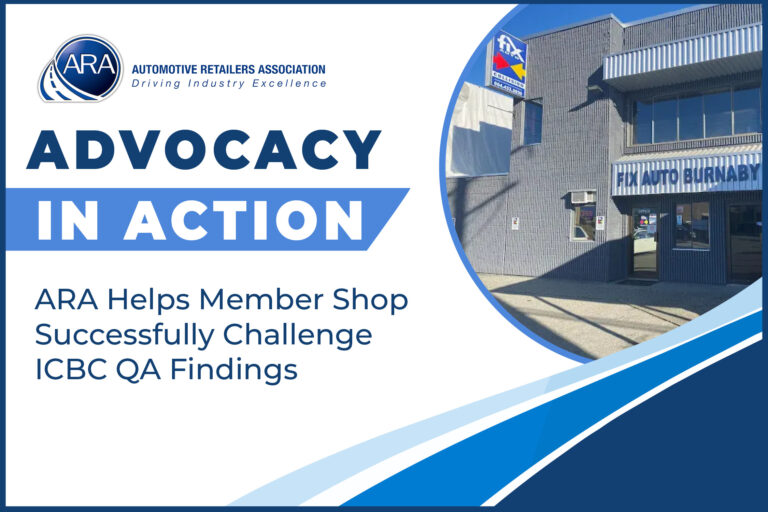
Written by Steve Wolfe
When a member shop receives a Quality Assurance (QA) finding that appears inconsistent with repair procedures, the Automotive Retailers Association (ARA) is committed to helping ensure repair decisions are based on sound technical evidence. That commitment recently resulted in a successful outcome for Sameer Akram and the team at Fix Auto Burnaby South.
The shop received two QA findings related to a 2024 Mazda CX-5 repair. The first involved refinishing procedures associated with a rocker panel replacement. The second questioned whether removal of the wheel opening moulding was required to remove the front bumper cover.
After reviewing the file, the ARA worked with the shop to prepare a detailed technical response. Regarding the refinish operation, ARA noted that the rocker panel repair area extended into the centre pillar with no natural break between panels. Applying paint only to the rocker would have required an unsupported solvent blend within a panel, contrary to accepted paint manufacturer warranty requirements.
The second issue involved removal of the wheel opening moulding. While estimate system information suggested the moulding was not required to be removed, photo evidence and OEM repair procedures demonstrated that the moulding physically overlaps and attaches directly to the front bumper. ARA’s review concluded that removal was necessary to safely and properly remove the bumper assembly without risking damage to undamaged components.
Following submission of the technical response, the QA findings were reassessed and ultimately reversed. In a follow-up email to ARA, the shop confirmed that the file had been returned to 100 percent compliance and thanked the association for its assistance.
This case highlights the importance of combining technician experience, OEM repair information, and real-world repair knowledge when evaluating repair procedures. It also demonstrates the value of the ARA’s advocacy program in helping members navigate disputes and ensuring collision repairs are assessed based on proper repair standards rather than assumptions or incomplete information